
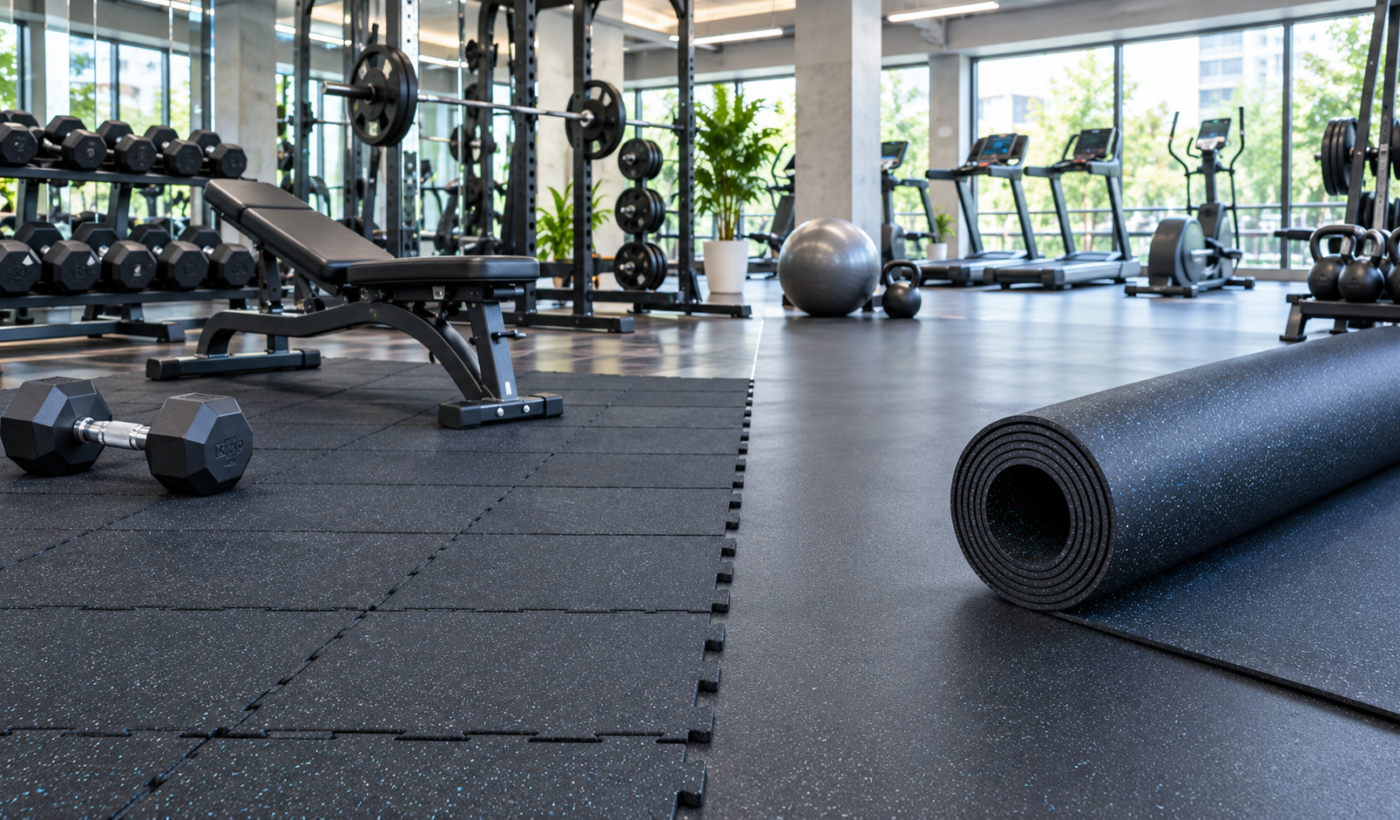
Choosing gym flooring sounds simple until you start comparing the options. You need something that handles heavy equipment, constant foot traffic, and daily workouts without wearing out too quickly. Plus, the floor should be easy to clean and comfortable for different exercises. That’s why rubber flooring is a common choice for commercial gyms, fitness studios, and home workout spaces. However, gym owners often struggle to choose between rubber tiles and rubber rolls. Both offer durability and impact protection, but they serve different needs.
Understanding their differences can help you select flooring that suits your space, budget, and workout activities.
Features of Rubber Tiles in Different Gym Areas
Rubber tiles are separate pieces that should be placed on the floor side by side, either with interlocking edges or using glue for installation.
One feature of this type of flooring is great flexibility. For instance, rubber tiles are perfect for small gyms, weightlifting zones, and rooms with irregular shapes. Moreover, tiles are easier to carry through narrow doors and staircases.
Easy repairs are another feature of such flooring. When there is a damaged tile, you can easily remove it without removing the whole floor. As a result, maintenance becomes easier.
Features of Rubber Rolls and Why They May Be a Good Choice
Rubber rolls are separate pieces that should also be placed side by side on the floor. They are commonly used in cardio and fitness studio zones, as well as other training zones.
A feature of this type of flooring is that fewer seams create a smooth and uniform surface. Besides, there are fewer places for collecting dust and dirt in the seams.
However, the installation process requires more effort since rolls are heavier and you need to do careful measurements and cutting. Thus, professional installation may be required, particularly when installing near the walls, columns, and equipment.
Differences Between Rubber Tiles and Rolls in Usage
Despite their common features, there are several differences that become evident in installation and usage.
- Installation: Rubber tiles are easier to work with in small areas. Meanwhile, rubber rolls are better when you need to cover large areas.
- Maintenance: A damaged tile can be replaced separately. However, the repair of a rubber roll may include cutting and replacing the part of the sheet.
- Appearance: Rolls give a uniform appearance due to fewer seams. Meanwhile, tiles can be installed with different patterns, colours, and workout zones.
- Impact Protection: Both types of flooring provide impact protection, but it depends on the thickness of the layer, rubber density, and the types of activities.
Can Rubber Tiles and Rolls Be Used Together?
There is no reason not to use them together because it makes sense in some cases. For example, rubber rolls can be used for cardio and training zones, while rubber tiles with greater thickness can be used in the free-weight zone.
However, you still may need specialised flooring for the heavy lifting zone.
Factors You Need to Consider Before Choosing Flooring
First, think about the layout of the room and exercises that will be done there. Then, pay attention to the thickness, durability, cleaning and installation cost.
Moreover, check the subfloor condition before installing new flooring since it will affect the flooring’s functionality.
If you expect changes in layout in the future, tiles will be more flexible. Meanwhile, rolls are better for covering large, uniform areas.
Conclusion
Thus, tiles are more flexible and convenient for maintenance, while rolls give a uniform appearance. However, the final choice depends on your gym needs.
For manufacturers who produce rubber tiles, rolls and other rubber flooring, Atlas PU Systems offers polyurethane binders. Discover Atlas PU solutions that help you develop your rubber gym flooring products.