
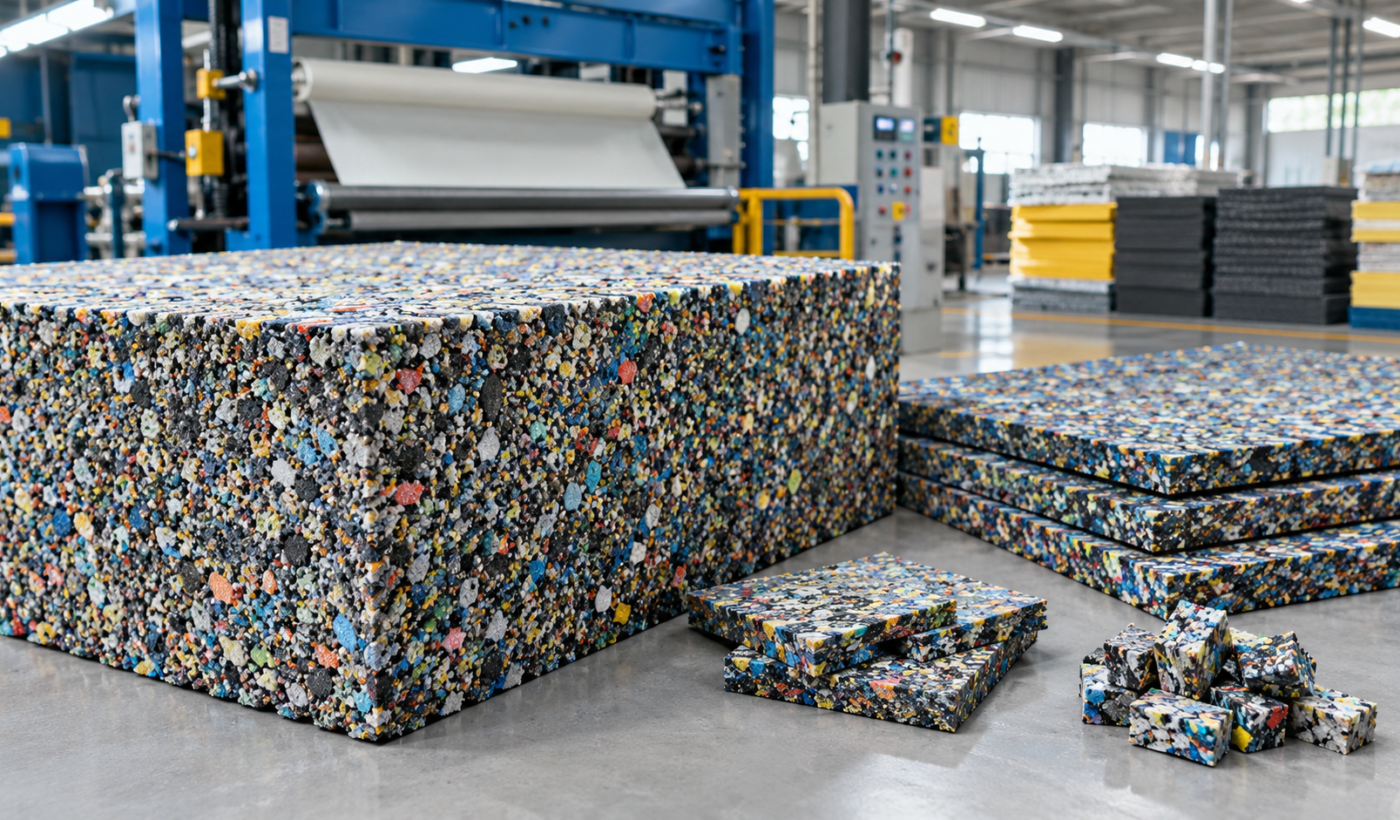
Foam waste can be a real challenge for manufacturers. Large amounts of leftover material often take up valuable space, even though much of it can still be useful. Throwing it away may seem like the easiest option, but it also means losing material that could serve another purpose.
This is where rebonded foam offers a practical solution. It turns suitable leftover polyurethane foam into a dense, supportive material used in many products. From gym mats to furniture cushioning, its uses are quite varied. Understanding how it is made can help you choose the right material for your manufacturing needs.
Why Rebonded Foam Has Its Strength
Rebonded foam, also known as bonded foam, is manufactured by binding together small particles of polyurethane foam in one compact block.
Unlike ordinary foam material, rebonded foam consists of lots of tiny foam particles that are bound into one piece.
Depending on the particular application, manufacturers can adjust both its density and firmness level.
Production Process of Rebonded Foam
To manufacture rebonded foam, manufacturers need to pass through several stages.
At first, manufacturers collect and separate all suitable foam scraps. Next, the collected material undergoes shredding into small particles. After that, the particles are mixed with a special binder, usually based on polyurethane foam.
The mixture goes inside the mould and is pressed there. After that, the binder is cured either using steam or without steam application. In the end, manufacturers cut the resulting foam block into sheets, blocks or any other necessary form.
However, the final quality of the foam material depends on the foam grade, binder and compression process.
Applications of Rebonded Foam
Due to its dense structure, rebonded foam material has several applications:
- gym and sports mats for cushioning and shock absorption;
- flooring underlays for adding support beneath carpets and flooring;
- furniture for providing cushioning for suitable seating applications;
- packaging for protecting products during transportation;
- sound control for reducing sound vibrations in certain designs.
Advantages of Rebonded Foam for Manufacturers
The primary advantage is the possibility of giving another life to suitable foam scraps. Thus, manufacturers can make full use of their scrap material.
Also, the use of rebonded foam allows manufacturers to create material with adjustable firmness, cushioning and flexibility depending on the product.
However, in order to achieve satisfactory results, manufacturers should carefully control particle size, binder quality and density of the material.
Conclusion
Thus, rebonded foam can serve as a helpful way to recycle foam material and use it in the manufacturing process.
For more information on bonding solutions, feel free to contact us at Atlas PU Systems.
